It’s the first of November, and I tell myself the same lie.
This year will be different. This year, I won’t get my hopes up. This year, I’ll be reasonable about Illinois basketball. I’ll temper my expectations instead of losing it. I’ll remember that it’s just a game, that sports are entertainment, and I shouldn’t tie my emotional well-being to student-athletes I’ve never met.
And then I watched the exhibition game against Illinois State.
Illinois deployed a zone defense. A zone. Under Brad Underwood. I would never have believed it without seeing it in person. New assistant coach Cam Crocker implemented a defensive look we haven’t seen in Champaign during the Underwood years.
What happened? Oh, nothing much, just casually adjusting the entire defensive philosophy because it fits this roster better in certain moments. Not all the time. Just when the matchup demands it. Out of a timeout. On an in-bounds play. When the situation calls for something different.
Most coaches have an identity. They build a system and recruit players to fit it. You know what you’re getting: the five-out offense guy, the pack-line defense guy, the press-and-run guy. They’re brands. They’re predictable.
Underwood? He’s a chameleon.
Look at his track record. At Stephen F. Austin, he led a high-octane offense that ranked first in tempo nationally. At Oklahoma State, he slowed it down and became a defensive specialist. At Illinois, he’s been whatever the roster needed him to be, sometimes within the same season.
Two years ago, he added “booty ball” to the arsenal. When you have size and strength down low, you use them. You post up. You grind. You make opponents feel you physically. It was an adjustment to the system because the personnel demanded it. Marcus Domask excelled at it. The scheme served the players, not the other way around.
Two seasons ago, Illinois reached the Elite Eight for the first time since 2005. Last year felt like a step back. The squad finished 22-13, advanced to the Round of 32, and saw both Kasparas Jakucionis and Will Riley declare for the NBA draft. It was a perfectly fine season for most programs. For Illinois? It felt like a missed opportunity.
So what does Underwood and his assistant coaches do this year? He raids Europe again. Illinois added a 22-year-old Serbian point guard who’s been playing professional basketball for years, the 7-foot twin of last year’s Croatian center, a versatile forward from Montenegro with handles, rebounding ability, and an attitude, plus the coveted off-season transfer son of NBA legend Peja Stojakovic. Suddenly, the Balkan band of brothers emerges.
That zone defense in the exhibition? That wasn’t Underwood abandoning his principles. That was him and Coach Crocker recognizing that when you have Tomislav and Zvonimir Ivisic, two 7-footers who can shoot threes and protect the rim, you’d be an idiot not to use their length differently when the situation calls for it. The scheme serves the players. It won’t be zone all the time, just in the right moments when it gives Illinois an advantage. A wrinkle. Another thing opponents have to prepare for.
Underwood’s flexibility means you can’t prepare for Illinois the same way twice.
Last year’s team? Opponents could game-plan more easily. Force the ball out of Jakucionis’s hands, make Riley beat you off the dribble, pack the paint, and dare our shooters to kill you from three. Teams figured it out.
This year’s team? Good luck.
Illinois landed Mihailo Petrovic, a grown man who’s been playing against professionals in the Adriatic League. However, he might not even be the starter. That’s how deep this roster is. There’s Kylan Boswell, who’s entering his senior season and ready to step into a bigger role as the offensive initiator, knock-down defender, and floor general. You’ve got the Ivisic twins, who can play inside-out basketball that most American centers can’t replicate.
David Mirkovic, the 6’9” Montenegrin forward who was a point guard until just a couple of years ago, was a surprise in the exhibition. He brings “booty ball” back to Champaign with his physical presence in the post, but he also has the passing vision and three-point shooting of a guard. He’s skilled, strong, and precisely the kind of versatile weapon Underwood loves.
Illinois is the newest destination for Andrej Stojakovic, the California transfer who averaged 17.9 points per game in the ACC last season. The son of NBA sharpshooter Peja Stojakovic, he’s a 6’7” wing who can score in all three facets: catch and shoot, off the dribble, and post-ups. He’s the crunch-time option Illinois lacked last year.
Plus, there’s the wildcard: Keaton Wagler. People are talking about him, sure. But here’s the thing, he’s the X factor. A 6’6” freshman shooting guard from Kansas who shot 50 percent from three as a junior in high school. The kind of developmental player that high-level programs need for deep tournament runs.
And you’ve got Underwood, who will look at what you’re doing defensively and just change. He’ll look at what’s working offensively and change the game plan. Mid-game. Mid-season. Whenever. It’s what he did with Domask and booty-ball. It’s what he did when he landed Kofi Cockburn.
This year’s squad looks like the most adaptable Underwood has had at Illinois. Just like him.
Want to play man-to-man? He’ll space you out with five guys who can shoot. Want to zone up? He’ll put both twins on the floor and have them pass over your heads. Want to slow the tempo? He’ll press. Want to run? He’ll slow it down and methodically dismantle you with ball screens in the half-court. Want to go small and play fast? He might throw a 2-3 zone at you with those 7-footers clogging every passing lane.
The non-conference slate tells you everything you need to know about Underwood’s mindset. After opening on November 3 against Jackson State, Illinois has non-conference games against Texas Tech, Alabama, UConn, and Tennessee. It’s a murderer’s row of talented teams to test this Illinois squad.
He scheduled this gauntlet to see what breaks. He wants to know if the zone holds up against elite spacing. He wants to discover if Petrovic or Boswell should run the point. He wants to find out if the Ivisic twins can stay on the floor in March-level competition. He wants to see if Wagler can be that shooter who makes defenses pay. He wants to test whether Mirkovic can bring a physical, post-up game while also stretching the floor. He wants to find out if Stojakovic can be the go-to scorer when the game is on the line.
Most coaches would look at an international roster with language barriers and cultural adjustments and try to keep things simple. Underwood looks at it and thinks, “What if we make it more complicated for our opponents?”
That’s either genius or insanity. With Underwood, it’s probably both.
Last year’s team was talented. The team made the tournament and won games. However, I think that when opposing teams figured out the offense, Illinois didn’t have much beyond Plan A. This year, there’s also Plan B(oswell) through Plan Z(vonimir).
Will it work? I have no idea. There will be games in January when nothing clicks, when the international players look lost, and when Underwood’s adjustments come too late. I’ll probably watch the team lose to a bottom-feeder Big Ten program and declare the season over.
Every year, I look for the method to the madness. The madness is the roster construction, the international experiment, the challenging non-conference schedule, the willingness to run zone defense when you’ve built your career on man-to-man, and the uncertainty about who even starts at point guard. The method is Underwood’s refusal to be locked into any single identity.
Illinois checks in at No. 17 in the AP Poll. KenPom has the team at No. 6. That’s good to see before the team runs the tunnel for real at State Farm Center.
It doesn’t mean a thing.
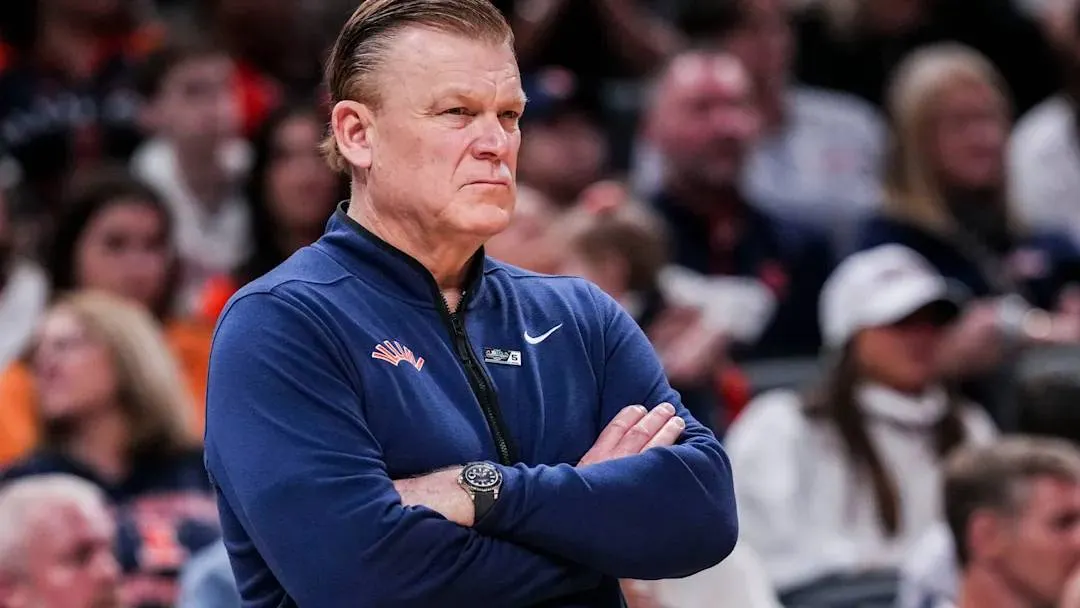
The season tips off on Monday. Boswell and Tomi Ivisic will bring the leadership. Stojakovic will look for his spots. Mirkovic will bring the physicality. Wagler is the one player who could make this whole thing work. The bench will be ready to showcase this team’s depth. Finally, Underwood will pace the sideline watching, calculating, already thinking ahead.
Of course, I’ll be watching, convinced this year will be the one. Not because the team has elite talent (though it might), not because the rankings are higher (though they are), but because we have a coach who has adapted to this new era of college basketball.
I can’t help but believe. I see a roster so deep and versatile that opponents won’t know what hit them. New defensive schemes. Year two in the program for a couple of veterans.
On paper, it looks more than promising.
The rankings are out, the first game is coming up, and Brad Underwood is already making adjustments.
That’s the method. That’s the madness.
Be seeing you.